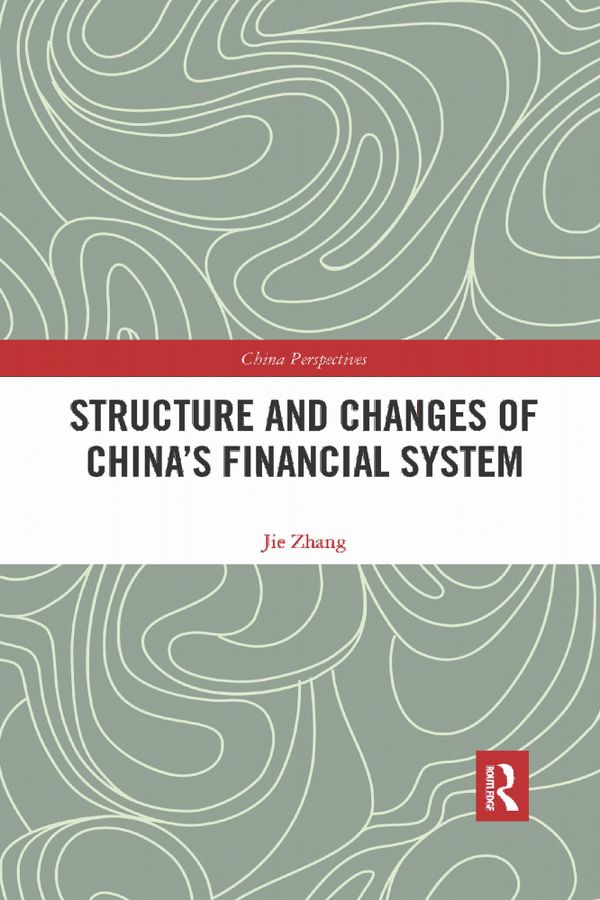
Structure and Changes of China’s Financial System | 1:a upplagan
- Danskt band, Engelska, 2020
- Författare: Jie Zhang
- Betyg:
Skickas inom 11-22 vardagar
Vill du sälja den här boken?
Sälj den här bokenFler utgåvor
-
A Comprehensive Study of Tang Poetry I (2021)
1954 kr
-
A Comprehensive Study of Tang Poetry II (2021)
2254 kr
-
China in the Eyes of the Japanese (2020)
2140 kr
-
Re-globalisation (2020)
1954 kr
-
The Complexity of Rural Migration in China (2020)
2521 kr
-
Avoiding the ‘Thucydides Trap’ (2020)
1954 kr
-
Shortening the Distance between Government and Public in China I (2020)
1954 kr
-
Shortening the Distance between Government and Public in China II (2020)
1954 kr
-
Syrian Civil War and Europe (2020)
1954 kr
-
Fiscal Policy and Institutional Renovation in Support of Innovative Country Building (2020)
3091 kr
-
Woven Arch Bridge (2020)
3091 kr
-
Technological Innovation and Economic Development in Modern Japan (2020)
1954 kr
-
China's Maritime Boundaries in the South China Sea (2020)
1954 kr
-
The Metaphysics of Philosophical Daoism (2020)
2143 kr
-
The Principles of New Ethics I (2020)
2346 kr
-
The Principles of New Ethics II (2020)
1954 kr
-
Contemporary Studies on Modern Chinese History I (2020)
1954 kr
-
Contemporary Studies on Modern Chinese History II (2020)
1954 kr
-
China’s Fiscal Policy (2020)
558 kr
-
Identity Constructions in Bilingual Advertising (2020)
643 kr


Beskrivning
To begin with, it examines the relation between state utility function and China’s economic growth, and reveals the formation and transition of China’s state-owned financial institutional arrangements. Based on this analysis, the author studies the influence of monetization on the arrangements, and the financial support to China’s gradual reform which have long been neglected by researchers. Also, the model of money demand that can explain the specific conditions of the gradual reform is built, as the neoclassical framework has been incapable of explaining China’s financial performance. In the last chapter, it discusses the dilemma of property rights under the state-owned financial system, with the establishment of the credit equilibrium model and the dual model of bad debts.
With insightful theoretical analysis and empirical researches, this book will appeal to scholars and students in finance, economics and economic history.
Om denna bok
Structure and Changes of China’s Financial System av Jie Zhang är en Danskt band bok med 152 sidor på Engelska. Detta är den 1:a upplagan som utgavs 2020.
Spara pengar – köp begagnad från Campusbokhandeln
Köp Structure and Changes of China’s Financial System begagnad från Campusbokhandeln och spara upp till 25% jämfört med nypris. Du kan bevaka den här boken så får du ett mail så fort vi får in den i lager som begagnad.
Genom att köpa & sälja begagnat sänker du kostnaden för studier både för dig och nästa student samtidigt som du gör nytta för klimatet.
Produktinformation