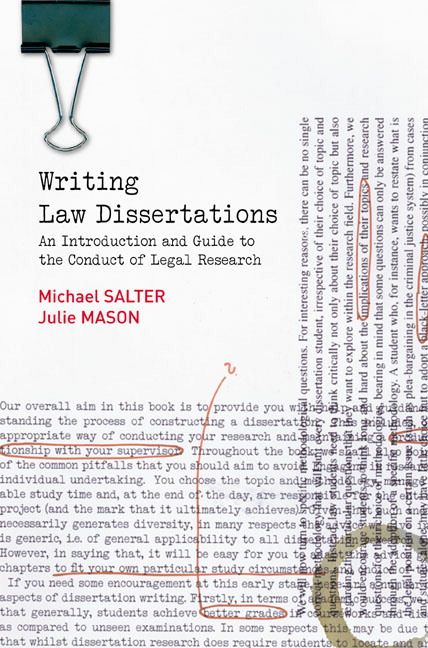
Writing Law Dissertations
- Häftad, Engelska, 2007
- Författare: Michael Salter, Julie Mason
- Betyg:
Skickas inom 1-3 vardagar
Vill du sälja den här boken?
Sälj den här bokenBeskrivning
CONTENTS
Introduction
Chapter 1. How to Begin
- Introduction
- What is 'research'?
- What is a 'dissertation'?
- How to choose your dissertation topic
- Specific suggestions for getting you started
- Identifying the key issues and marginal issues in your dissertation
- Is the research viable in practice?
- Putting pen to paper
- Conclusion
Chapter 2. Getting Along With Your Supervisor
- Introduction
- Choosing your supervisor
- When to choose
- What can you expect from your supervisor?
- The role of the dissertation supervisor
- Devise your own 'learning contract'
- At the beginning of your supervision
- Writing the dissertation
- Meeting your supervisor
- Reviewing draft chapters
- How much supervision?
- Making the most of constructive criticism and formative feedback
- Common problems with supervision
- Conclusion
Chapter 3. Selecting Suitable Approaches to the Conduct of Dissertation Research
- Introduction
- Resistance to methodological discussion
- Positive reasons for engaging in methodological discussion
- Recognising the implications of the tension between different research methodologies
- Avoiding the pitfalls of selecting an inappropriate methodology
- Conclusion
Chapter 4. Black-Letter Approaches to Doctrinal Research
- Introduction
- Towards a provisional working definition: black-letter law as legal formalism
- Other features of the black-letter approach
- The centrality of classic textbooks
- Insulating the dissertation topic from ‘external’ factors
- Setting and answering the question: what is the legal position on X?
- The requirement to reveal a system of underlying principles ordering legal rules
- Searching for coherence and systematic order
- Legal principles and rules are largely determinate
- The standpoint of black-letter analysis
- Wider strategies of selective exclusion
- The focus on law in books
- Deductive methods of reasoning from first principles
- Law as a distinct and unique discipline
- The restricted character of black-letter forms of criticism of law
- Questions of evaluation: the advantages and problems of black-letter analysis
- Conclusion
Chapter 5. Sociolegal Approaches to the Conduct of Dissertation Research
- Introduction
- Defining sociolegal studies
- The diversity of topics and themes addressed by sociolegal studies
- The emphasis on law in action
- Policy and the power of ideologies
- The diversity of research methods used in sociolegal studies
- Ethical and other normative dimensions
- Strengths and criticisms of sociolegal approaches
- Conclusion
Chapter 6. Comparative and Historical Methods
- Introduction
- Comparative approaches
- Comparative historical approaches
- Historical methodologies more generally
- Sociolegal histories of criminal justice
- The legal regulation of property and housing
- International and comparative sociolegal histories
- Public law, civil liberties and human rights
- Social welfare and family policy
- The legal regulation of professions
- Black-letter versions of legal history
- Conclusion
Conclusion
Further Reading and Bibliography
Om denna bok
Writing Law Dissertations av Michael Salter och Julie Mason är en Häftad bok med 256 sidor på Engelska. Den utgavs 2007 av Pearson Education.
Spara pengar – köp begagnad från Campusbokhandeln
Köp Writing Law Dissertations begagnad från Campusbokhandeln och spara upp till 25% jämfört med nypris. Du kan bevaka den här boken så får du ett mail så fort vi får in den i lager som begagnad.
Genom att köpa & sälja begagnat sänker du kostnaden för studier både för dig och nästa student samtidigt som du gör nytta för klimatet.
Produktinformation