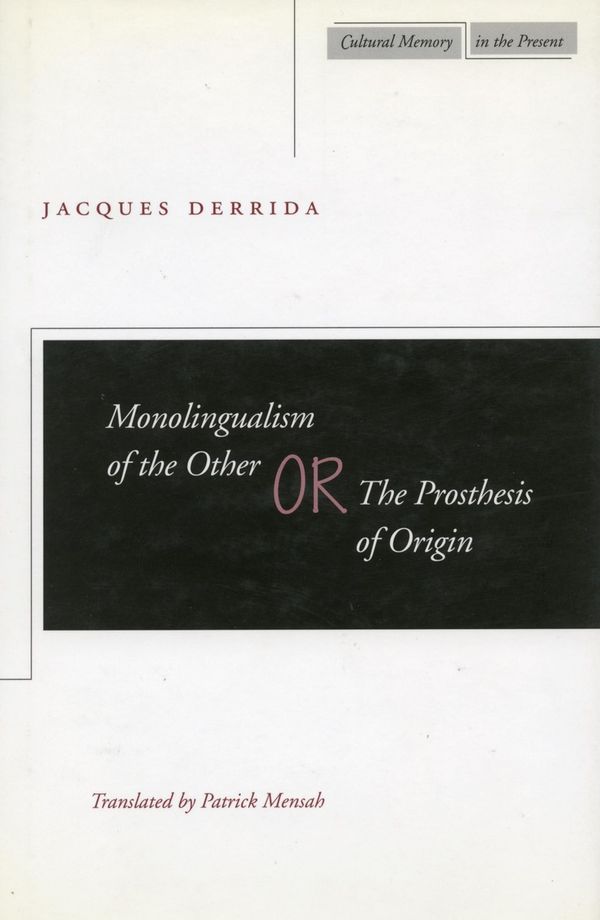
Monolingualism of the Other
- Danskt band, Engelska, 1998
- Författare: Jacques Derrida
- Betyg:
Skickas inom 0-2 vardagar
Vill du sälja den här boken?
Sälj den här bokenFler utgåvor
-
Being with the Dead (2019)
277 kr
-
Sediments of Time (2018)
352 kr
-
Parages (2010)
288 kr
-
Occidental Eschatology (2009)
265 kr
-
Multidirectional Memory (2009)
315 kr
-
The Angel of History (2008)
271 kr
-
Lessons from a Materialist Thinker (2008)
246 kr
-
Naming the Witch (2005)
271 kr
-
A Finite Thinking (2003)
382 kr
-
The Jew, the Arab (2003)
295 kr
-
Saint Paul (2003)
234 kr
-
Formations of the Secular (2003)
81 kr
-
Husserl's Phenomenology (2002)
246 kr
-
Being Given (2002)
396 kr
-
Making a Nation, Breaking a Nation (1998)
344 kr


Beskrivning
The book operates on three levels. At the first level, a theoretical inquiry investigates the relation between individuals and their "own" language. It also explores the structural limits, desires, and interdictions inherent in such "possession," as well as the corporeal aspect of language (its accents, tones, and rhythms) and the question of the "countability" of languages (that is, their discreteness or factual givenness).
At the second level, the author testifies to aspects of his acculturation as an Algerian Jew with respect to language acquisition, schooling, citizenship, and the dynamics of cultural-political exclusion and inclusion. At the third level, the book is comparative, drawing on statements from a wide range of figures, from the Moroccan Abdelkebir Khatibi to Franz Rosenzweig, Gershom Scholem, Hannah Arendt, and Emmanuel Levinas.
Since one of the book's central themes is the question of linguistic and cultural identity, its argument touches on several issues relevant to the current debates on multiculturalism. These issues include the implementation of colonialism in the schools, the tacit or explicit censorship that excludes other (indigenous) languages from serious critical consideration, the investment in an ideal of linguistic purity, and the problematics of translation. The author also reveals the complex interplay of psychological factors that invests the subject of identity with the desire to recover a "lost" language of origin and with the ambition to master the language of the colonizer.
Om denna bok
Monolingualism of the Other av Jacques Derrida är en Danskt band bok med 112 sidor på Engelska. Den utgavs 1998 av Marston.
Spara pengar – köp begagnad från Campusbokhandeln
Köp Monolingualism of the Other begagnad från Campusbokhandeln och spara upp till 25% jämfört med nypris. Du kan bevaka den här boken så får du ett mail så fort vi får in den i lager som begagnad.
Genom att köpa & sälja begagnat sänker du kostnaden för studier både för dig och nästa student samtidigt som du gör nytta för klimatet.
Produktinformation