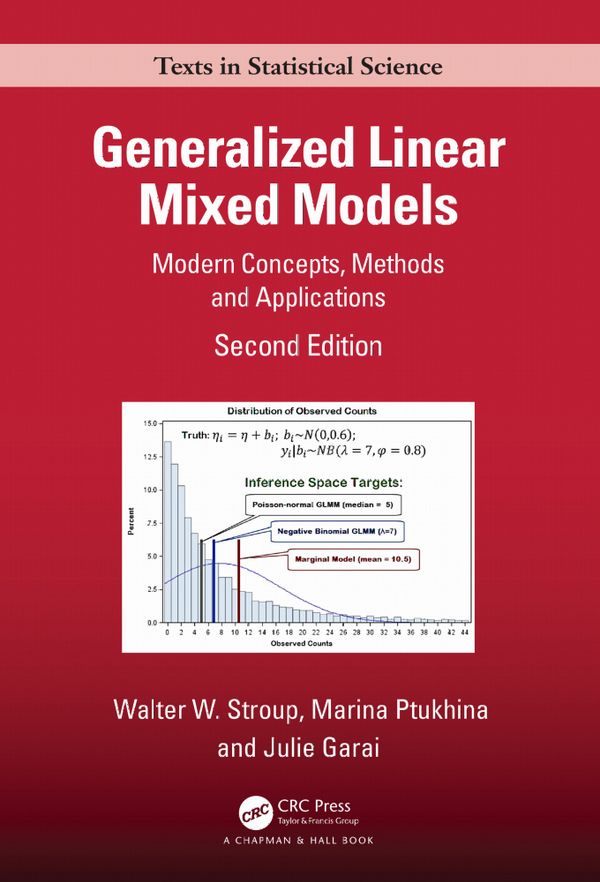
Generalized Linear Mixed Models | 2:a upplagan
- Danskt band, Engelska, 2024
- Författare: Walter W. Stroup, Marina Ptukhina, Julie Garai
- Betyg:
Skickas inom 0-2 vardagar
Vill du sälja den här boken?
Sälj den här bokenFler utgåvor
-
Bayes Rules! (2022)
391 kr
-
Practical Multivariate Analysis (2021)
643 kr
-
Linear Models with Python (2020)
1341 kr
-
Principles of Uncertainty (2020)
1569 kr
-
A Computational Approach to Statistical Learning (2020)
643 kr
-
Introduction to Multivariate Analysis (2020)
643 kr
-
Extending the Linear Model with R (2016)
1340 kr
-
Mathematical Statistics (2015)
1435 kr
-
Design and Analysis of Experiments with R (2014)
1568 kr
-
Bayesian Data Analysis (2013)
1430 kr


Beskrivning
Unlike textbooks that focus on classical linear models or generalized linear models or mixed models, this book covers all of the above as members of a unified GLMM family of linear models. In addition to essential theory and methodology, this book features a rich collection of examples using SAS® software to illustrate GLMM practice. This second edition is updated to reflect lessons learned and experience gained regarding best practices and modeling choices faced by GLMM practitioners. New to this edition are two chapters focusing on Bayesian methods for GLMMs.
Key Features:
Most statistical modeling books cover classical linear models or advanced generalized and mixed models; this book covers all members of the GLMM family – classical and advanced models
Incorporates lessons learned from experience and on-going research to provide up-to-date examples of best practices
Illustrates connections between statistical design and modeling: guidelines for translating study design into appropriate model and in-depth illustrations of how to implement these guidelines; use of GLMM methods to improve planning and design
Discusses the difference between marginal and conditional models, differences in the inference space they are intended to address and when each type of model is appropriate
In addition to likelihood-based frequentist estimation and inference, provides a brief introduction to Bayesian methods for GLMMs
Om denna bok
Generalized Linear Mixed Models av Walter W. Stroup, Marina Ptukhina och Julie Garai är en Danskt band bok med 648 sidor på Engelska. Detta är den 2:a upplagan som utgavs 2024 av Taylor & Francis Ltd.
Spara pengar – köp begagnad från Campusbokhandeln
Köp Generalized Linear Mixed Models begagnad från Campusbokhandeln och spara upp till 25% jämfört med nypris. Du kan bevaka den här boken så får du ett mail så fort vi får in den i lager som begagnad.
Genom att köpa & sälja begagnat sänker du kostnaden för studier både för dig och nästa student samtidigt som du gör nytta för klimatet.
Produktinformation