Vi flyttar från butik till nätet - så funkar det framåt
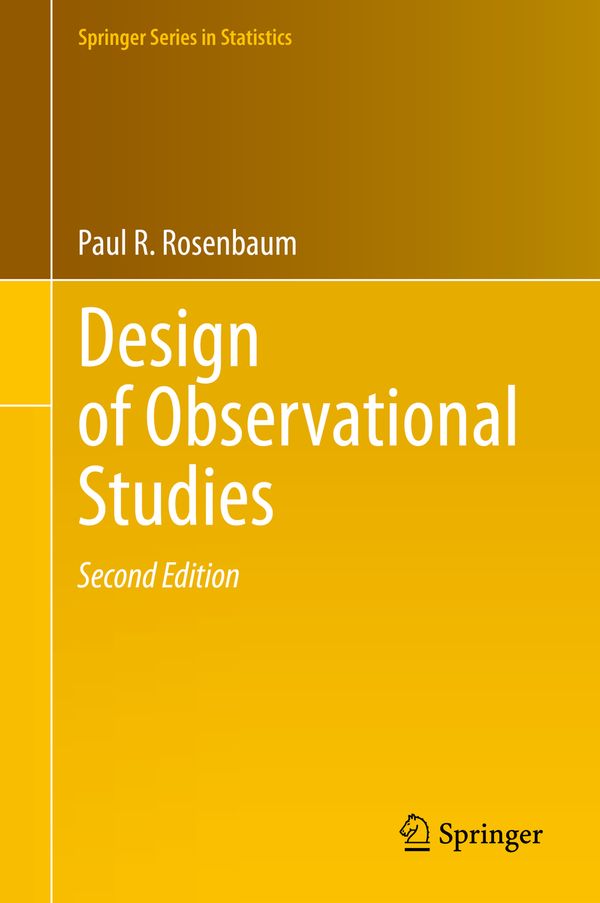
Design of Observational Studies | 2:a upplagan
- Danskt band, Engelska, 2020
- Författare: Paul R. Rosenbaum
- Betyg:
1712
kr
Skickas inom 1-3 vardagar
Onlinelager
I lager hos leverantör
Vill du sälja den här boken?
Sälj den här boken
Beskrivning
This second edition of Design of Observational Studies is both an introduction to statistical inference in observational studies and a detailed discussion of the principles that guide the design of observational studies. An observational study is an empiric investigation of effects caused by treatments when randomized experimentation is unethical or infeasible. Observational studies are common in most fields that study the effects of treatments on people, including medicine, economics, epidemiology, education, psychology, political science and sociology. The quality and strength of evidence provided by an observational study is determined largely by its design.
Design of Observational Studies is organized into five parts. Chapters 2, 3, and 5 of Part I cover concisely many of the ideas discussed in Rosenbaum’s Observational Studies (also published by Springer) but in a less technical fashion. Part II discusses the practical aspects of using propensity scores and other tools to create a matched comparison that balances many covariates, and includes an updated chapter on matching in R. In Part III, the concept of design sensitivity is used to appraise the relative ability of competing designs to distinguish treatment effects from biases due to unmeasured covariates. Part IV is new to this edition; it discusses evidence factors and the computerized construction of more than one comparison group. Part V discusses planning the analysis of an observational study, with particular reference to Sir Ronald Fisher’s striking advice for observational studies: "make your theories elaborate."
This new edition features updated exploration of causal influence, with four new chapters, a new R package DOS2 designed as a companion for the book, and discussion of several of the latest matching packages for R. In particular, DOS2 allows readers to reproduce many analyses from Design of Observational Studies.
Design of Observational Studies is organized into five parts. Chapters 2, 3, and 5 of Part I cover concisely many of the ideas discussed in Rosenbaum’s Observational Studies (also published by Springer) but in a less technical fashion. Part II discusses the practical aspects of using propensity scores and other tools to create a matched comparison that balances many covariates, and includes an updated chapter on matching in R. In Part III, the concept of design sensitivity is used to appraise the relative ability of competing designs to distinguish treatment effects from biases due to unmeasured covariates. Part IV is new to this edition; it discusses evidence factors and the computerized construction of more than one comparison group. Part V discusses planning the analysis of an observational study, with particular reference to Sir Ronald Fisher’s striking advice for observational studies: "make your theories elaborate."
This new edition features updated exploration of causal influence, with four new chapters, a new R package DOS2 designed as a companion for the book, and discussion of several of the latest matching packages for R. In particular, DOS2 allows readers to reproduce many analyses from Design of Observational Studies.
Om denna bok
Design of Observational Studies av Paul R. Rosenbaum är en Danskt band bok med 547 sidor på Engelska. Detta är den 2:a upplagan som utgavs 2020 av Springer Nature.
Spara pengar – köp begagnad från Campusbokhandeln
Köp Design of Observational Studies begagnad från Campusbokhandeln och spara upp till 25% jämfört med nypris. Du kan bevaka den här boken så får du ett mail så fort vi får in den i lager som begagnad.
Genom att köpa & sälja begagnat sänker du kostnaden för studier både för dig och nästa student samtidigt som du gör nytta för klimatet.
Produktinformation
Kategori:
Filosofi & idéhistoria
Bandtyp:
Danskt band
Språk:
Engelska
ISBN:
9783030464042
Upplaga:
2
Utgiven:
2020-07-14
Förlag:
Springer Nature
Sidantal:
547