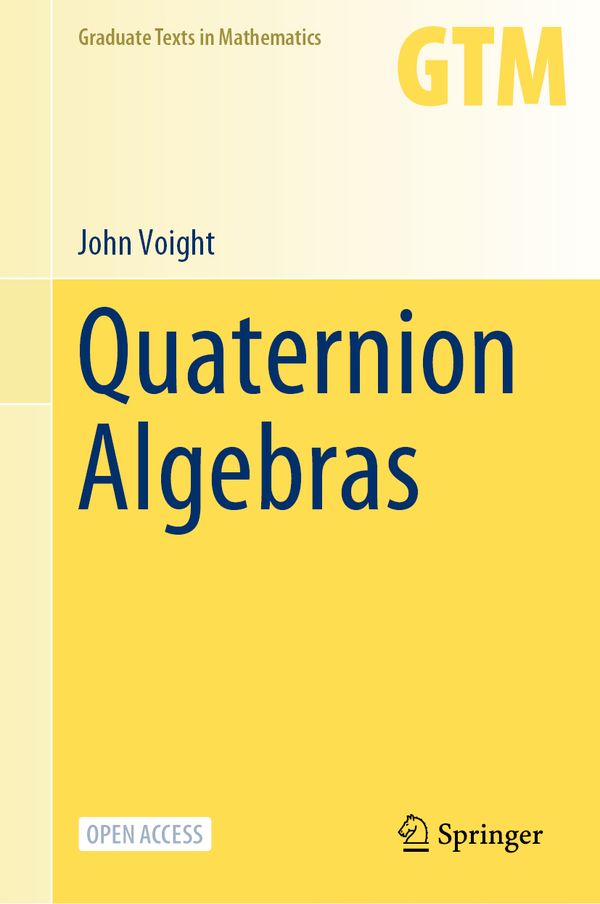
Quaternion Algebras | 1:a upplagan
- Danskt band, Engelska, 2021
- Författare: John Voight
- Betyg:
Skickas inom 6-10 vardagar
Vill du sälja den här boken?
Sälj den här bokenFler utgåvor
-
Essentials of Integration Theory for Analysis (2020)
878 kr
-
Measure, Integration & Real Analysis (2019)
738 kr
-
Binomial Ideals (2019)
254 kr
-
A Course in Differential Geometry (2013)
1076 kr
-
Introduction to Smooth Manifolds (2012)
860 kr
-
Algebraic K-Theory and Its Applications (2011)
710 kr
-
Algebraic Geometry (2010)
817 kr
-
Categories for the Working Mathematician (2010)
612 kr
-
The Arithmetic of Elliptic Curves (2010)
632 kr
-
Advanced Linear Algebra (2007)
663 kr
-
The Geometry of Syzygies (2005)
439 kr
-
Complex Analysis (1998)
784 kr
-
Moduli of Curves (1998)
710 kr
-
Galois Theory (1997)
710 kr
-
Classical Topics in Complex Function Theory (1997)
873 kr
-
Functions of One Complex Variable II (1995)
537 kr
-
Algebraic Number Theory (1994)
647 kr
-
Local Fields (1980)
624 kr
-
Differential Topology (1976)
841 kr


Beskrivning
Divided into five parts, the book begins with a basic introduction to the noncommutative algebra underlying the theory of quaternion algebras over fields, including the relationship to quadratic forms. An in-depth exploration of the arithmetic of quaternion algebras and orders follows. The third part considers analytic aspects, starting with zeta functions and then passing to an idelic approach, offering a pathway from local to global that includes strong approximation. Applications of unitgroups of quaternion orders to hyperbolic geometry and low-dimensional topology follow, relating geometric and topological properties to arithmetic invariants. Arithmetic geometry completes the volume, including quaternionic aspects of modular forms, supersingular elliptic curves, and the moduli of QM abelian surfaces.
Quaternion Algebras encompasses a vast wealth of knowledge at the intersection of many fields. Graduate students interested in algebra, geometry, and number theory will appreciate the many avenues and connections to be explored. Instructors will find numerous options for constructing introductory and advanced courses, while researchers will value the all-embracing treatment. Readers are assumed to have some familiarity with algebraic number theory and commutative algebra, as well as the fundamentals of linear algebra, topology, and complex analysis. More advanced topics call upon additional background, as noted, though essential concepts andmotivation are recapped throughout.
Om denna bok
Quaternion Algebras av John Voight är en Danskt band bok med 885 sidor på Engelska. Detta är den 1:a upplagan som utgavs 2021 av Springer Nature.
Spara pengar – köp begagnad från Campusbokhandeln
Köp Quaternion Algebras begagnad från Campusbokhandeln och spara upp till 25% jämfört med nypris. Du kan bevaka den här boken så får du ett mail så fort vi får in den i lager som begagnad.
Genom att köpa & sälja begagnat sänker du kostnaden för studier både för dig och nästa student samtidigt som du gör nytta för klimatet.
Produktinformation