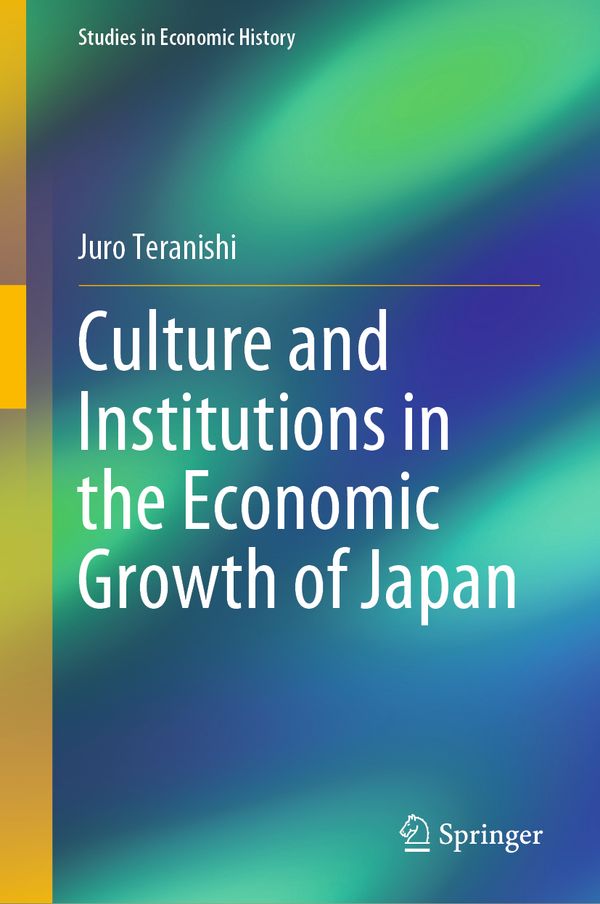
Culture and Institutions in the Economic Growth of Japan | 1:a upplagan
- Danskt band, Engelska, 2020
- Författare: Juro Teranishi
- Betyg:
Skickas inom 1-3 vardagar
Vill du sälja den här boken?
Sälj den här bokenFler utgåvor
-
Historical Statistics of Korea (2022)
3039 kr
-
The Japanese Economy During the Great Depression (2021)
1383 kr
-
Studies in Economic History (2020)
745 kr


Beskrivning
In the Occident, institutions have been pivotal in structuring and ordering the market economy and coordinating incentives of economic agents, as is emphasized by Douglas North. The author of this book argues that culture, defined as historically transmitted beliefs and values specific to each nation, may fulfill similar roles by establishing conventions and norms of behavior of individuals.
Japan before the Meiji Restoration (1868) seems to be a typical case. The book presents an analysis of the formation of its internalized part of mental model, owing to religious reform in Buddhism in the thirteenth century and the consequent emergence of commerce-based growth driven by a decline in transaction costs in the Tokugawa Era, from the seventeenth through the mid-nineteenth centuries. Institutions had been largely inefficient due to serious cultural conflicts among classes, especially between the samurai and aristocrats. The relative costs of establishing and enforcing institutions were low in the Occident where internalized beliefs were based on the concept of public, by and large common among individuals; by contrast, in Japan, where internalized beliefs were strongly influenced by others nearby, that differed significantly among individuals, the costs were high because of difficulty in sharing mental models. The economic development of the Occident owed largely to the development of industrial technology nurtured under the development of various institutional devices to coordinate activities, whereas the economic growth of Japan during the Tokugawa Era was causedby the decrease in transaction costs in commercial activities owing to the standardization of conduct nurtured through the deliberate development of culture and to the efforts of small producers enhanced by religious motivation.
After the Meiji Restoration, Occidental institutions and industrial technology flowed into Japan rapidly, and the Japanese enthusiastically absorbed the Occidental cultural system crystalized in Enlightenment values. At the same time, the struggle of Meiji leaders to establish national integrity and spirit was an attempt to adapt imported Occidental institutions to the traditional internalized culture and to maintain the merits of historical tradition as much as possible. The book argues that it is not easy to implement fusion or substitution of traditional internalized culture with any “advanced” culture of foreign societies.
Om denna bok
Culture and Institutions in the Economic Growth of Japan av Juro Teranishi är en Danskt band bok med 387 sidor på Engelska. Detta är den 1:a upplagan som utgavs 2020.
Spara pengar – köp begagnad från Campusbokhandeln
Köp Culture and Institutions in the Economic Growth of Japan begagnad från Campusbokhandeln och spara upp till 25% jämfört med nypris. Du kan bevaka den här boken så får du ett mail så fort vi får in den i lager som begagnad.
Genom att köpa & sälja begagnat sänker du kostnaden för studier både för dig och nästa student samtidigt som du gör nytta för klimatet.
Produktinformation