Vi flyttar från butik till nätet - så funkar det framåt
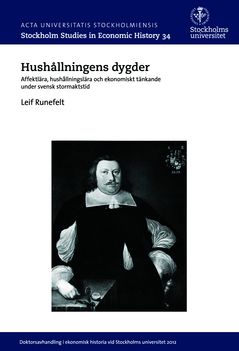
Hushållningens dygder : Affektlära, hushållningslära och ekonomiskt tänkande under svensk stormaktstid
- Häftad, Svenska, 2015
- Författare: Leif Runefelt
- Betyg:
150
kr
Skickas inom 0-2 vardagar
Onlinelager
I lager hos leverantör
Vill du sälja den här boken?
Sälj den här bokenBeskrivning
A basic assumption in the thesis is that every economic as well as political and ethical doctrine contains a conception of man, and, thus, that this conception needs to be scrutinised in order to achieve deeper understanding of the doctrine. The purposes of the thesis is (1) to account for conceptions of man within the rarely studied Swedish seventeenth-century economic thought, (2) to examine how conceptions of man and of society influence and shape this thought, and (3) to do this from a synchronous approach, by which emphasis is laid on economic thought as an integral part of the intellectual culture of the epoch. In chapter 2 is explored the conception of man as expressed in economic thought. Man is conceived as selfish and irrational. In chapter 3, this conception is explained as it is placed within a wider context, the most common psychological theory of the epoch, the theory of the passions, which is thoroughly examined. Chapter 4 consists of an analysis of the theory of householding, as it was expressed in the literature of the epoch. It is shown that this theory, not focused on by earlier research, to a large extent is a part of ethics and a prolongation of the theory of passions. The householder or "house-father" is obliged to control his own as well as the other household-member's passions, and to maintain the hierarchical order within the household. Chapters 5 to 8 deal with the central areas within economic thought. These areas are domestic production and trade (ch. 5), the sumptuary laws and attitudes towards luxury (ch. 6), the use of the concept of free trade (ch. 7) and the issues of idleness and employment (ch. 8). It is shown that the king or government is viewed as the "house-father" of the realm, and that the core of the theory of the passions, the taming of the passions through reason and virtue, is vital also within economic thought, in which four virtues were central: justice, diligence, temperance and frugality; the same virtues as in the theory of householding.
Om denna bok
Hushållningens dygder : Affektlära, hushållningslära och ekonomiskt tänkande under svensk stormaktstid av Leif Runefelt är en Häftad bok med 300 sidor på Svenska. Den utgavs 2015 av Stockholm University.
Spara pengar – köp begagnad från Campusbokhandeln
Köp Hushållningens dygder : Affektlära, hushållningslära och ekonomiskt tänkande under svensk stormaktstid begagnad från Campusbokhandeln och spara upp till 25% jämfört med nypris. Du kan bevaka den här boken så får du ett mail så fort vi får in den i lager som begagnad.
Genom att köpa & sälja begagnat sänker du kostnaden för studier både för dig och nästa student samtidigt som du gör nytta för klimatet.
Produktinformation
Kategori:
Ekonomi & management
Bandtyp:
Häftad
Språk:
Svenska
ISBN:
9789176098615
Utgiven:
2015-09-02
Förlag:
Stockholm University
Sidantal:
300