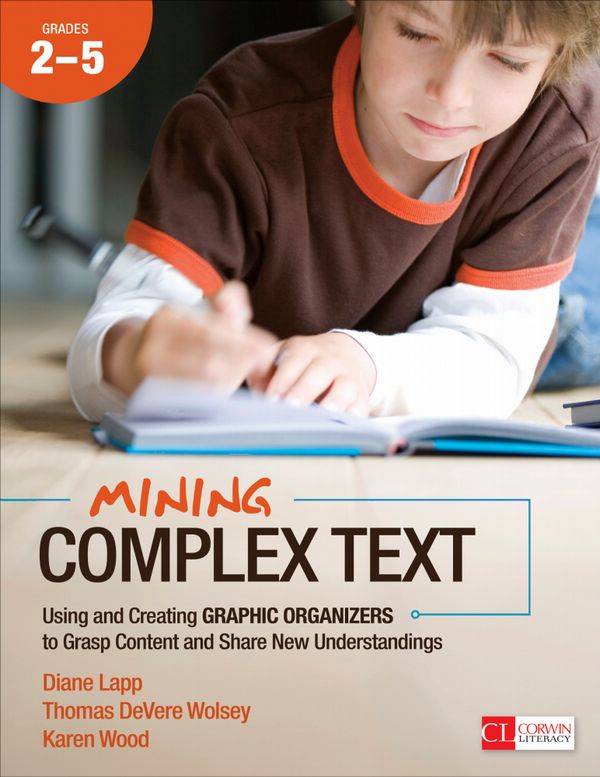
Mining Complex Text, Grades 2-5 | 1:a upplagan
- Danskt band, Engelska, 2014
- Författare: Thomas DeVere Wolsey, Karen D. Wood, Diane K. Lapp
- Betyg:
Skickas inom 1-3 vardagar
Vill du sälja den här boken?
Sälj den här bokenFler utgåvor
-
The Ramped-Up Read Aloud (2019)
364 kr
-
What Are You Grouping For?, Grades 3-8 (2018)
443 kr
-
These 6 Things (2018)
410 kr
-
Word Study That Sticks (2018)
426 kr
-
Writers Read Better: Nonfiction (2018)
404 kr
-
Text Structures From Nursery Rhymes (2017)
520 kr
-
A Fresh Look at Phonics, Grades K-2 (2016)
395 kr
-
Academic Moves for College and Career Readiness, Grades 6-12 (2015)
431 kr
-
Grammar Keepers (2015)
466 kr
-
Text-Dependent Questions, Grades K-5 (2014)
375 kr
-
Uncommon Core (2014)
459 kr
-
The Nonfiction Now Lesson Bank, Grades 4-8 (2014)
430 kr


Beskrivning
—DOUGLAS FISHER
Coauthor of Rigorous Reading
Imagine you are a fourth grader, reading about our solar system for the first time. Or you’re a high school student, asked to compare survival in Suzanne Collin’s The Hunger Games and Elie Wiesel’s Night. Reading complex texts of any kind is arduous, and now more than ever, students are being asked to do highly advanced thinking, talking, and writing around their reading. If only there were ingenious new power tools that could give students the space to tease apart complex ideas in order to comprehend and to weld their understandings into a new whole.
Good news: such tools exist. In the two volumes, Mining Complex Texts, Grades 2-5 and 6-12, a formidable author team shares fresh ways to use the best digital and print graphic organizers in whole-class, small-group, and independent learning. Big believers of the gradual release method, the authors roll out dozens of examples of dynamic lessons and collaborative work across the content areas so that we see the process of using these visual tools to:
Help students read, reread, and take notes on a text
Promote students’ oral sharing of information and their ideas
Elevate organized note-making from complex text(s)
Scaffold students’ narrative and informational writing
Move students to independent thinking as they learn to create their own organizing and note-taking systems
Gone are the days of fill-‘em-in and forget-‘em graphic organizers. With these two volumes, teachers and professional development leaders have a unified vision of how to use these tools to meet the demands of an information-saturated world, one in which students need to be able to sift, sort, synthesize, and apply knowledge with alacrity and skill.
Om denna bok
Mining Complex Text, Grades 2-5 av Thomas DeVere Wolsey, Karen D. Wood och Diane K. Lapp är en Danskt band bok med 184 sidor på Engelska. Detta är den 1:a upplagan som utgavs 2014 av SAGE Publications Ltd.
Spara pengar – köp begagnad från Campusbokhandeln
Köp Mining Complex Text, Grades 2-5 begagnad från Campusbokhandeln och spara upp till 25% jämfört med nypris. Du kan bevaka den här boken så får du ett mail så fort vi får in den i lager som begagnad.
Genom att köpa & sälja begagnat sänker du kostnaden för studier både för dig och nästa student samtidigt som du gör nytta för klimatet.
Produktinformation