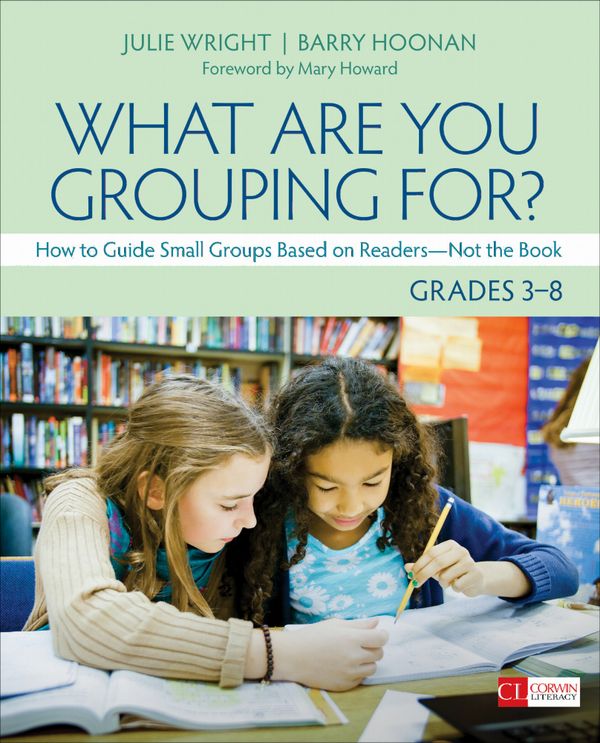
What Are You Grouping For?, Grades 3-8 | 1:a upplagan
- Danskt band, Engelska, 2018
- Författare: Julie T. Wright, Barry Thomas Hoonan
- Betyg:
Skickas inom 1-3 vardagar
Vill du sälja den här boken?
Sälj den här bokenFler utgåvor
-
The Ramped-Up Read Aloud (2019)
364 kr
-
These 6 Things (2018)
410 kr
-
Word Study That Sticks (2018)
426 kr
-
Writers Read Better: Nonfiction (2018)
404 kr
-
Text Structures From Nursery Rhymes (2017)
520 kr
-
A Fresh Look at Phonics, Grades K-2 (2016)
395 kr
-
Academic Moves for College and Career Readiness, Grades 6-12 (2015)
431 kr
-
Grammar Keepers (2015)
466 kr
-
Mining Complex Text, Grades 2-5 (2014)
490 kr
-
Text-Dependent Questions, Grades K-5 (2014)
375 kr
-
Uncommon Core (2014)
459 kr
-
The Nonfiction Now Lesson Bank, Grades 4-8 (2014)
430 kr


Beskrivning
Like many educators in intermediate classrooms across the country, you may be using guided reading principles to teach reading. Whether you’re following targeted reading levels or sticking with your school’s established routines, chances are that guided reading has become synonymous with small group reading for you and your students. But . . . are your students getting the most out of small groups? Are readers of all ability levels experiencing the dynamic learning that can occur in small groups? Do you feel confident that the way you’re grouping kids is based on their wants and needs?
Intermediate grade readers don’t need to be guided as much as they need to be engaged—and authors Julie Wright and Barry Hoonan have solutions for doing just that using small groups. What Are You Grouping For? offers the practical tools, classroom examples, and actionable steps essential for starting, sustaining, and mastering the management of small groups. This book explains the five teacher moves that work together to support students’ reading independence through small group learning—kidwatching, pivoting, assessing, curating, and planning—and provides examples to guide you and your students toward success.
From must-have beginning-of-the-year strategies to step-by-step advice for implementation, this guide breaks down the processes that support small groups and help create effective instructional reading programs. Based on more than 45 years of combined experience in the classroom, this resource will empower you with tools to ensure that your readers are doing the reading, thinking, and doing—not you.
Om denna bok
What Are You Grouping For?, Grades 3-8 av Julie T. Wright och Barry Thomas Hoonan är en Danskt band bok med 352 sidor på Engelska. Detta är den 1:a upplagan som utgavs 2018 av SAGE Publications Ltd.
Spara pengar – köp begagnad från Campusbokhandeln
Köp What Are You Grouping For?, Grades 3-8 begagnad från Campusbokhandeln och spara upp till 25% jämfört med nypris. Du kan bevaka den här boken så får du ett mail så fort vi får in den i lager som begagnad.
Genom att köpa & sälja begagnat sänker du kostnaden för studier både för dig och nästa student samtidigt som du gör nytta för klimatet.
Produktinformation